Research Themes
Context-aware visual reasoning across computer vision, cultural heritage, and interpretive AI for the humanities.
Spatial and Visual Reasoning
Spatial intelligence for complex visual content
Building AI systems that can understand the structure of visual and 3D worlds, from objects and scenes to fragments, spaces, and changing environments. This research explores how machines can move beyond seeing to reasoning about layout, relationships, and physical context.
Related Publications
- → HistReNeRF: Historic Image Relocalisation within Contemporary Neural Radiance Field Reconstructions (2026)
- → Maps from Motion (MfM): Generating 2D Semantic Maps from Sparse Multi-view Images (2025)
- → 6DGS: 6D Pose Estimation from a Single Image and a 3D Gaussian Splatting Model (2024)
- → IFFNeRF: Initialisation Free and Fast 6DoF pose estimation from a single image and a NeRF model (2024)
- → PRAGO: Differentiable multi-view pose optimization from objectness detections (2024)
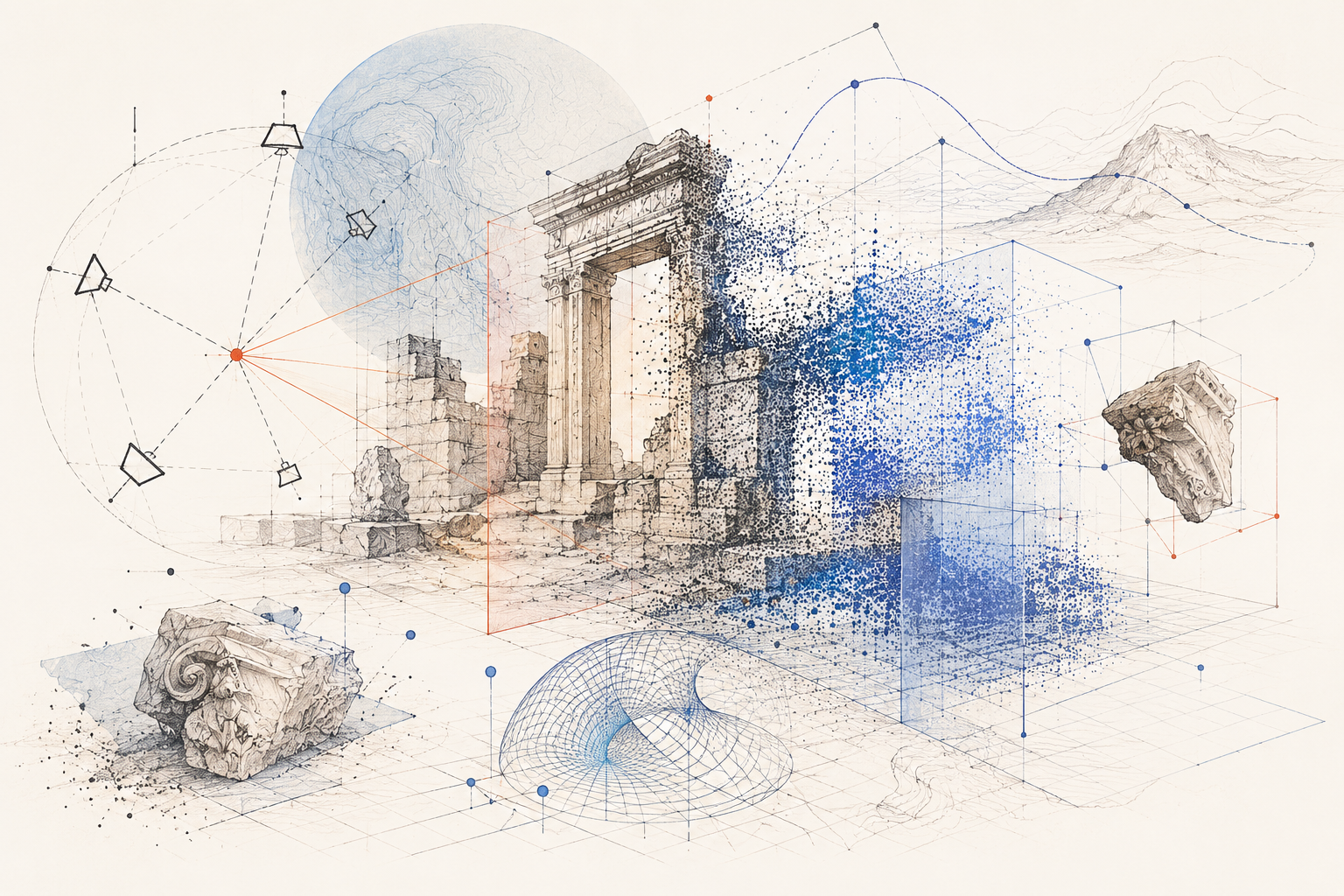
Image placeholder — see README
Multimodal and Contextual AI
Connecting vision, language, and knowledge for richer machine understanding.
Connecting images, text, spatial data, and knowledge to create richer forms of machine understanding. This theme focuses on AI that does not interpret data in isolation, but uses context to uncover relationships, meanings, and new lines of enquiry.
Related Publications
- → Maps from Motion (MfM): Generating 2D Semantic Maps from Sparse Multi-view Images (2025)
- → Locality-aware subgraphs for inductive link prediction in knowledge graphs (2023)
- → Writing with (Digital) Scissors: Designing a Text Editing Tool for Assisted Storytelling using Crowd-Generated Content (2022)
- → Geolocation of Cultural Heritage using Multi-View Knowledge Graph Embedding (2022)
- → Mixing Modalities of 3D Sketching and Speech for Interactive Model Retrieval in Virtual Reality (2021)
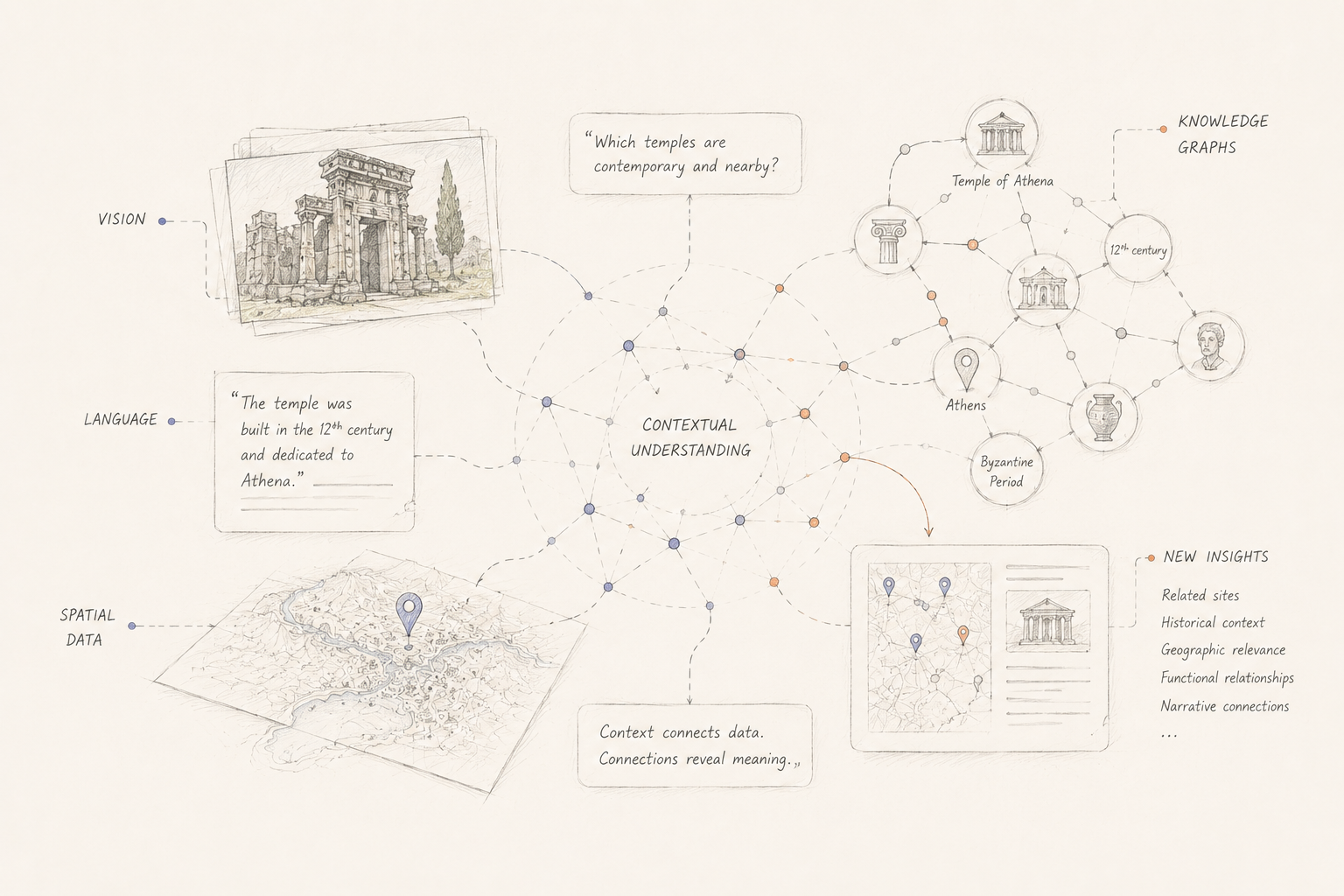
Image placeholder — see README
Human-Centred AI and Interactive Systems
Designing AI that supports interpretation, creativity, and collaboration.
Designing AI tools that support people in exploring, questioning, and interpreting complex information. The goal is to create interactive systems where computational methods extend human expertise, creativity, and critical judgement.
Related Publications
- → Exploring the Effects of Asynchronous Collaborative Art in VR with PaintBranch (2026)
- → PaintBranch: Asynchronous Collaborative Art in Virtual Reality (2025)
- → ArtAI4DS: AI Art and its Empowering Role in Digital Storytelling (2024)
- → Interactive Digital Storytelling Navigating the Inherent Currents of the Diasporic Mind (2024)
- → Inclusive Digital Storytelling: Artificial Intelligence and Augmented Reality to re-centre Stories from the Margins (2023)
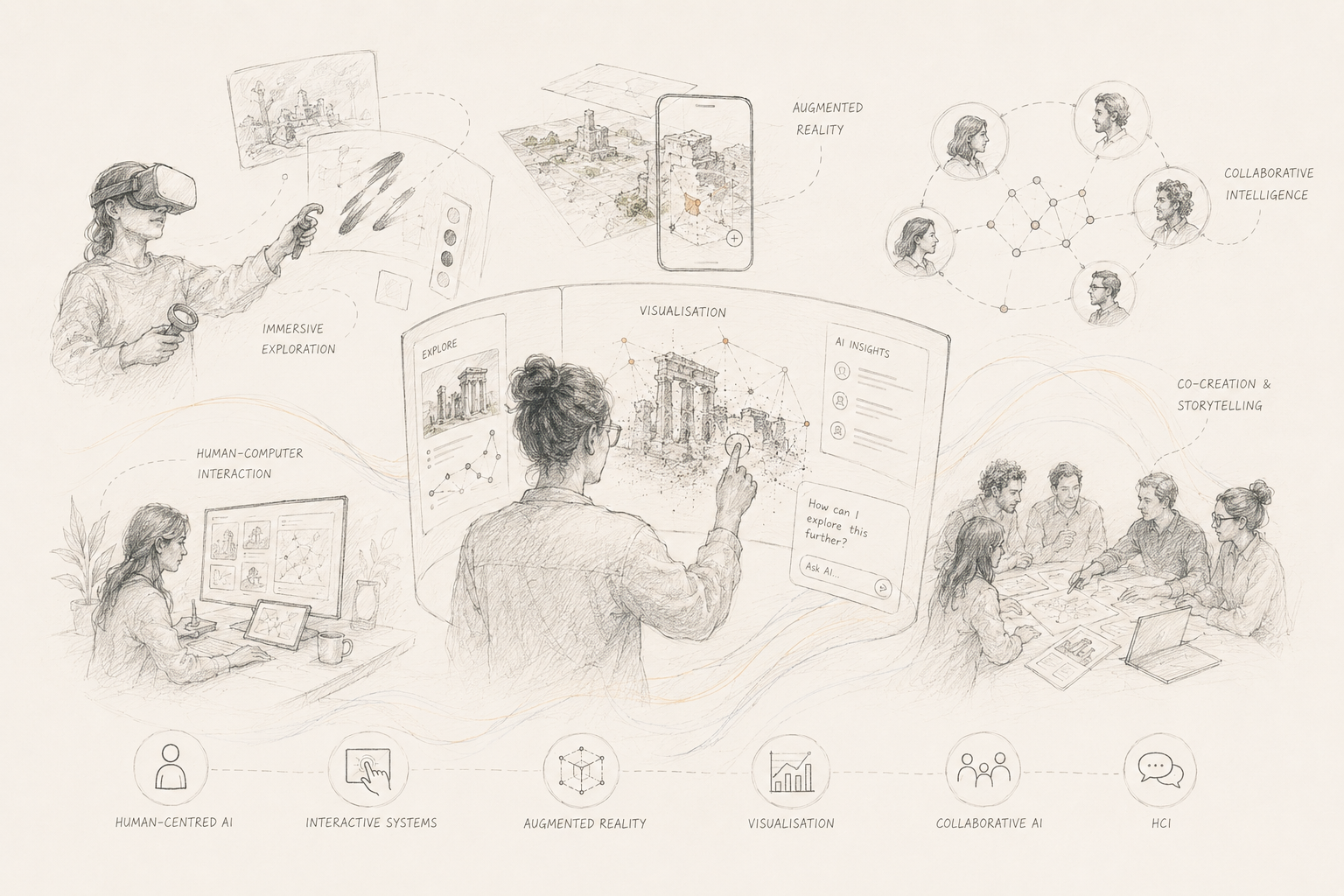
Image placeholder — see README
AI for Culture, Heritage, and Material Knowledge
Exploring culture and material history through visual computational intelligence.
Developing AI methods for studying artworks, artefacts, archaeological fragments, and historic environments. The work uses cultural heritage as a setting for advancing more interpretive, contextual, and human-aware forms of AI.
Related Publications
- → HistReNeRF: Historic Image Relocalisation within Contemporary Neural Radiance Field Reconstructions (2026)
- → E-M3RF: An Equivariant Multimodal 3D Re-assembly Framework (2026)
- → Exploring the Effects of Asynchronous Collaborative Art in VR with PaintBranch (2026)
- → ArtContext: Contextualizing Artworks with Open-Access Art History Articles and Wikidata Knowledge through a LoRA-Tuned CLIP Model (2026)
- → ReAssembleNet: Learnable Keypoints and Diffusion for 2D Fresco Reconstruction (2025)
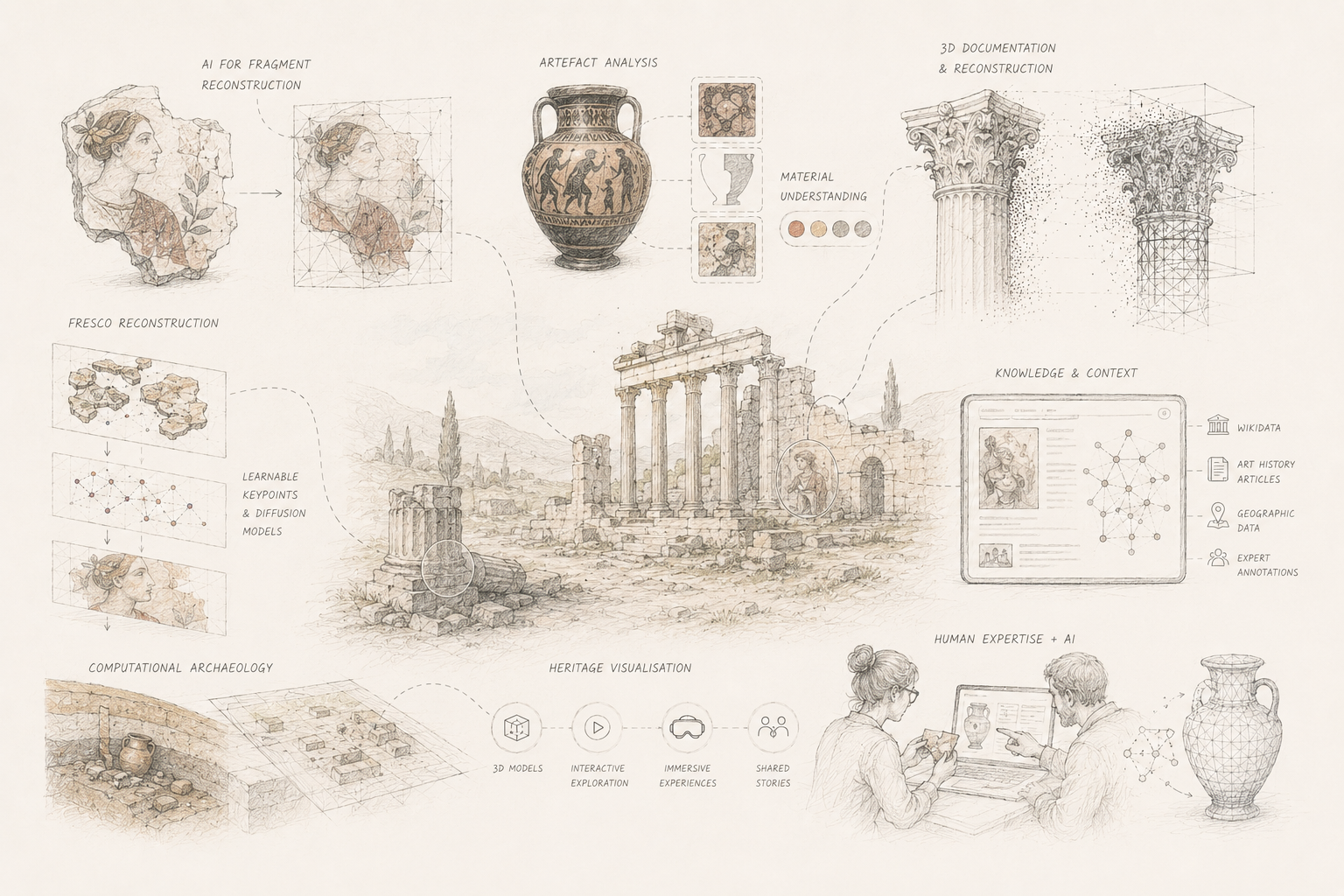
Image placeholder — see README
Research Grants
MoniRail KTP
April 2025–March 2028UKRI · Innovate UK Knowledge Transfer Partnership
A Knowledge Transfer Partnership focused on railway monitoring using computer vision and AI technologies. (Details to be announced.)
BoSS: Bauhaus of the Seas Sails
January 2023–December 2025European Union · Horizon Europe Lighthouse
Demonstrating solutions for climate neutrality with a focus on coastal cities. Seven lighthouse demonstrators across Portugal, Italy, Sweden/Germany, and the Netherlands/Belgium showcase innovative solutions for environmentally sustainable, socially fair, and aesthetically appealing transitions.
DCitizens: Fostering Digital Civics Research and Innovation in Lisbon
December 2022–November 2025European Union · Horizon Europe Twinning
Focuses on sustainability and resilience in public service delivery, binding IT research & innovation, government bodies, private service providers, and local communities to shape a new citizen-centred model for digital civics.
RePAIR: Reconstructing the Past — AI and Robotics Meet Cultural Heritage
September 2021–February 2025European Union · Horizon 2020 FET Open
Developing an intelligent robotic system that can autonomously process, match, and physically assemble large fractured artefacts. Tested on iconic case studies from the UNESCO World Heritage Site of Pompeii, restoring two world-renowned frescoes currently in thousands of broken pieces.
MEMEX: MEMories and EXperiences for inclusive digital storytelling
December 2019–November 2022European Union · Horizon 2020 RIA
Creating assisted augmented reality experiences in the form of stories that intertwine the memories of participating communities. Developing techniques to (semi-)automatically link images to location and connect to a new open-source knowledge graph, with a focus on Barcelona's migrant women and Parisian immigrant communities.